How to Spot Media Bias: A Practical Checklist
To spot media bias, look at how a story is told, not just what it says: loaded words, which sources get quoted, what is left out, whether the headline matches the body, and whether opinion is labeled. Then check the outlet itself: who owns it, whether it publishes corrections, and how independent raters such as AllSides, Ad Fontes Media and Media Bias/Fact Check score it.

On this page
What Media Bias Looks Like
Media bias is rarely an outright lie. More often it is a pattern in which stories get covered, which words are used, and whose voices are heard. A single article can be fair while the outlet’s overall coverage leans one way, which is why it helps to look at both the story and the source.
The Checklist: Eight Things to Look For
- Loaded words. “Regime” or “government”, “slashed” or “reduced”, “claimed” or “said”. Emotional or judgmental words tell you how the writer wants you to feel.
- Who gets quoted. Are several sides heard, or only one? Are experts named, or is it “critics say”?
- What is left out. Missing context, numbers without a baseline, or one side’s response not included.
- Headline vs body. Does the headline match what the article actually says? Headlines are often more slanted than the text.
- Story selection. Which stories does the outlet cover heavily, and which does it ignore? Bias by omission shows up across many articles, not one.
- Placement. What is at the top of the home page, and what is buried?
- Opinion labels. Is commentary clearly marked as opinion or analysis, or mixed into the news report?
- Images and captions. A photo can make the same person look heroic or ridiculous.
How to Check the Outlet Itself
- Ownership and funding. Who owns the outlet and how it makes money can create pressure. Each of our source profiles has a “Who funds it?” section.
- Corrections. Reliable outlets publish corrections when they get things wrong. Look for a corrections page or policy.
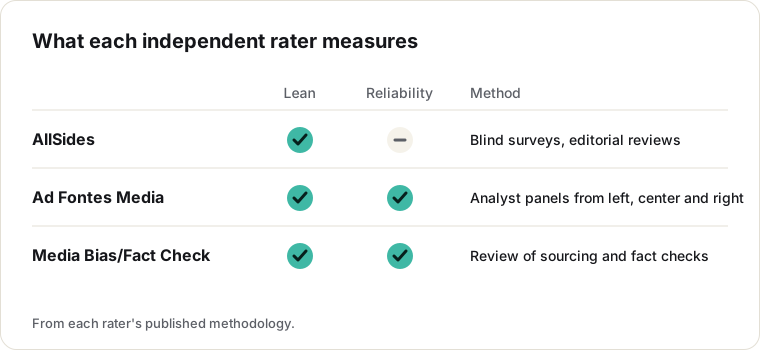
- Independent ratings. AllSides rates political lean using blind surveys and editorial reviews. Ad Fontes Media scores both lean and reliability with panels of analysts from across the spectrum. Media Bias/Fact Check rates lean and factual reporting. They don’t always agree, so it is worth seeing all three; our media bias chart puts them side by side.
Read Laterally
When you land on an unfamiliar source, don’t judge it only from its own “About” page. Open new tabs and see what independent sites say about it. Stanford researchers Sam Wineburg and Sarah McGrew found that professional fact-checkers do exactly this, and get to reliable answers faster than people who read the site closely.
Bias vs Reliability
Lean and accuracy are different questions. An outlet can lean left or right and still report facts carefully; another can sound neutral and get things wrong. That’s why raters score them separately, and why Aplomb’s six criteria require high reliability as well as a clear line between news and opinion.
Make It a Habit
You don’t need to run the full checklist on every story. Pick a few reliable outlets, read across the spectrum now and then, and run the checklist when a story makes you angry: that is when framing works best.
Want a calmer way to follow the news? Aplomb shows short videos from vetted newsrooms, no endless feed of opinions.
Newsrooms Mentioned in This Guide
FAQ
What is media bias?
A pattern in how an outlet chooses, frames or reports stories that consistently favors one side, viewpoint or group. It can be political, commercial or simply a blind spot.
How can I tell if a news source is biased?
Check its word choice, sourcing and story selection over several articles, then look it up: its ownership, its corrections policy, and its ratings from independent raters such as AllSides, Ad Fontes Media and Media Bias/Fact Check.
Is bias the same as fake news?
No. A biased story can be accurate but one-sided; fake news is false. Reliability ratings, such as Ad Fontes Media's reliability score or Media Bias/Fact Check's factual reporting rating, measure accuracy separately from lean.
What is lateral reading?
Checking a source by opening other tabs to see what independent sites say about it, instead of judging it only from its own pages. Stanford researchers found professional fact-checkers do this routinely.
More Guides