What Is a Wire Service? How Reuters, AP and AFP Supply the News
A wire service, or news agency, is a news organization that gathers news and sells it to other media: newspapers, broadcasters, websites and apps. The three biggest international wire services are Reuters, AP and AFP. Because their clients span the political spectrum, they write in a plain, factual style, and independent raters score them as highly reliable, with a lean close to the center.

On this page
What a Wire Service Does
A wire service, also called a news agency, gathers news and sells it to other media. Its reporters, photographers and video journalists cover events around the world, and its clients (newspapers, broadcasters, websites and apps) publish that material or build their own stories on it. The name comes from the telegraph wires that once carried the reports.
When a local paper runs a story about an earthquake on the other side of the world, the facts, photos and video very often come from a wire service.
The Big Three: Reuters, AP and AFP
| Agency | Founded | Headquarters | Ownership |
|---|---|---|---|
| Reuters | 1851 | London | Part of Thomson Reuters, a listed company about 70% owned by the Thomson family |
| AP | 1846 | New York City | Not-for-profit cooperative owned by its member news organizations |
| AFP | 1944 | Paris | Autonomous body set up by a 1957 French law, with no shareholders |
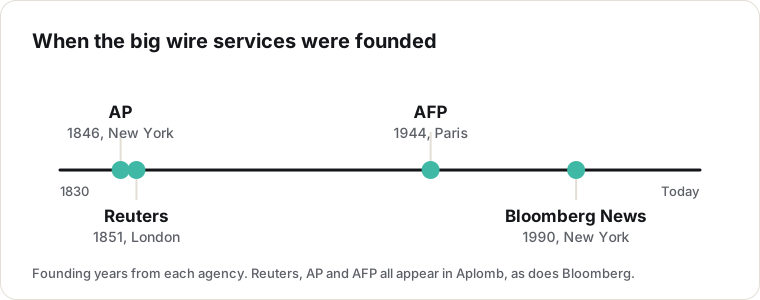
Bloomberg is often counted alongside them for financial news, though its main business is the Bloomberg Terminal, a data service for finance professionals.
How Wire Services Are Funded
Wire services mostly earn money by selling their reporting. Media organizations pay subscriptions to use the text, photos and video. Some have other income: Thomson Reuters sells professional and financial products, and the French state pays AFP compensation for its public-interest missions and buys subscriptions. Each source profile on Aplomb has a “Who funds it?” section with the details.
Why Wire Copy Tends to Be Factual
- Clients across the spectrum. An agency that sells to left- and right-leaning outlets alike has every reason to stick to verifiable facts.
- Speed and volume. Wire reports are written to be published fast, so they lead with what happened, who said it, and how it is known.
- Published standards. The big agencies publish their standards and corrections policies. Reuters, for example, operates under the Thomson Reuters Trust Principles, which commit it to independence and freedom from bias.
That doesn’t make wire services perfect. They still choose which stories to cover and which voices to quote. Raters also differ in the details: all three rate Reuters as center, while AllSides rates AP Lean Left and Media Bias/Fact Check rates AP and AFP Left-Center, with high factual reporting. See the media bias chart for their scores.
How to Spot Wire Stories
Look for a credit in the byline or at the end of an article: “(Reuters)”, “(AP)”, “(AFP)” or “Associated Press”. If many sites carry nearly identical text on a story, it probably comes from the same agency. Going to the agency directly gives you the report without each outlet’s headline and framing on top.
Wire services are at the core of Aplomb: Reuters, AP, AFP and Bloomberg are all in the feed, and The Canadian Press is in the Canada tab. Read how we choose our sources.
Want a calmer way to follow the news? Aplomb shows short videos from vetted newsrooms, no endless feed of opinions.
Newsrooms Mentioned in This Guide
FAQ
What is a wire service?
A news organization that gathers news and sells it to other media outlets, which publish it under the agency's name or use it in their own reporting. Also called a news agency.
What are the biggest wire services?
The three big international ones are Reuters (founded 1851, London), the Associated Press (founded 1846, New York) and Agence France-Presse (founded 1944, Paris). Bloomberg News is a large financial news service.
Are wire services unbiased?
No outlet is free of bias, but wire services are rated among the least biased because they sell to clients across the spectrum. Raters don't fully agree: all three rate Reuters as center, while AllSides rates AP Lean Left and Media Bias/Fact Check rates AP and AFP Left-Center. See each profile for the exact ratings.
Why do so many news sites carry the same story?
Often because they all buy it from the same wire service. Look for a credit such as (Reuters), (AP) or (AFP) at the top or bottom of the article.
More Guides